
The Government’s local organizations run on a budget allocated by the respective Ministries, and it is crucial to keep track of the budget to control the spending by planning the contracts, expenses, and salaries. Budget is also important to meet local compliance requirements like financial and audit regulations in the Government organizations.
Any Tier-1 ERP will help to meet these requirements, and Dynamics 365 Finance and Operations is among them, also there are challenges to fulfill 100% expectations. In Gulf countries, the requirement varies within different governments, one such case is treating the budget carry-forward to the purchase orders, contracts, and projects. Unlike developed countries like the US and Canada, they have pre-defined policies that help ERP providers to standardize the process, such as is use of Funds with budget.
Basics
In most cases, the original budget is created yearly and the planning is done prior 6 months in advance. The budget planning is taken in two approaches.
- Incremental budget – For salaries, recurring expenses like electricity, phone bills, and regular purchases like stationery and laptops.
- Value proposition budgeting – The new projects are proposed and are carefully considered by the committee like if the Government spending is really worth it.
Every year new budget is approved in different buckets by allocating the funds into segregated Accounts (Assets and Expenses), Business units, Locations, departments, Sections, purposes, and so on.
Example
AED 1 million – Expense ledger account – Entity Name – Location Dubai – Maintenance Department – Project Code.
The new Purchase requisitions and the purchase orders (and contracts) should be created by validating the above-allocated budget.
However, the amount is inclusive of the tax and the system should reserve a portion of the tax, in GCC countries the VAT is fixed, and in the UAE it is 5%. So, the budget limit for consumption should be set at a threshold value of 95%. It helps to avoid overconsumption.
During the year-end process, the open purchase orders are required to perform carry-forward operations, which is the process of changing the accounting dates to the new fiscal year. And different organization treats it differently. In most cases, the carry-forward amounts are reserved with the PO and should not be used for other purposes.
Configurations
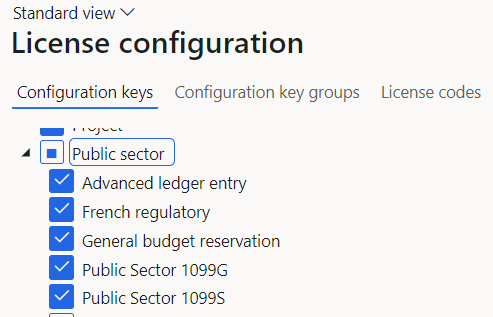
Enable public sector license and select only applicable
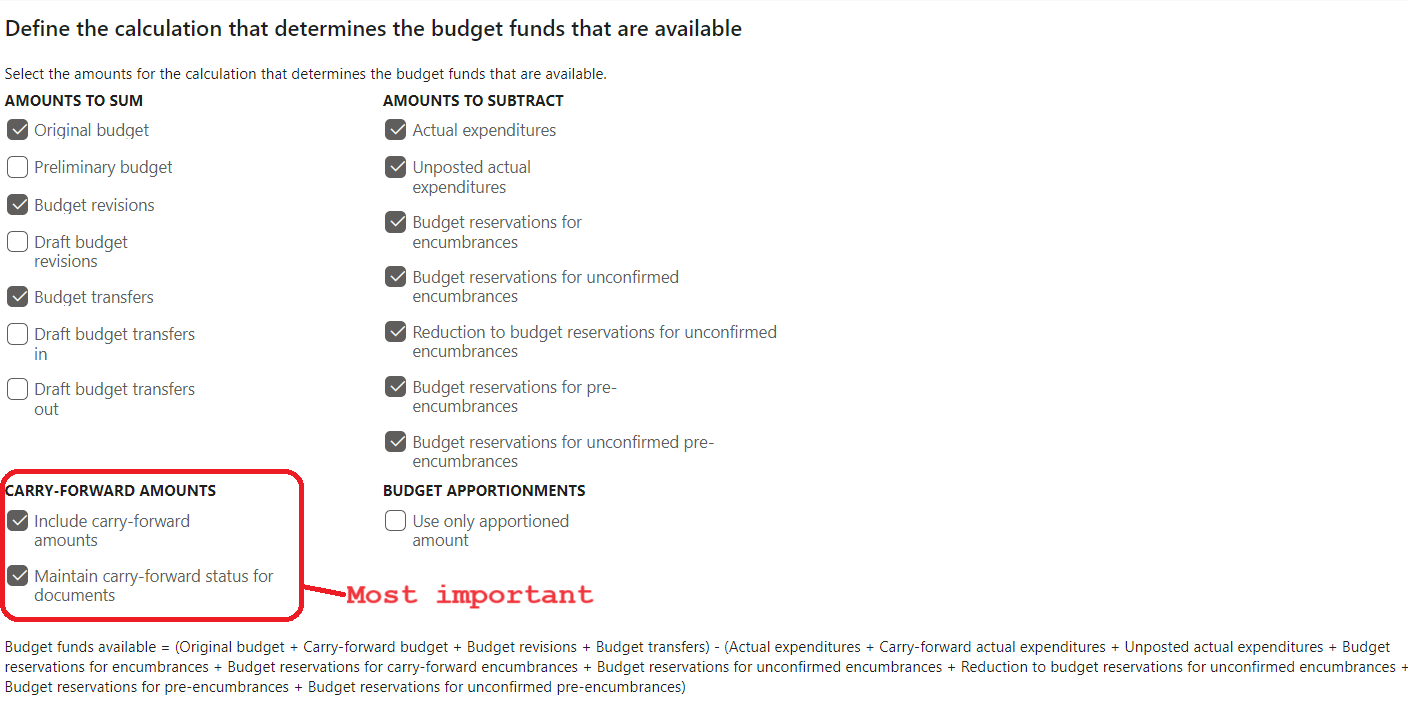
Budget funds available
Enable the PR (pre-encumbrance) draft and PO (encumbrance) draft as part of the available budget to avoid conflict. Maintaining carry-forward will help you keep the budget in the carr-forward bucket if the PO contains charges that impact reduction in the CF budget only.
Enable feature management
This feature safeguards your actual budget from the carry-forward budget.

Major issues still remain
- If the PO is modified then the budget is changed from carry-forward to the current year, this will create a major issue, as the requester may see there is a budget available this happens due to an extra line added as a correction to the accounting distribution in the PO. Solution, customize with the developer to not allow carry-forward PO to be edited. However, some fields have no impact on the budget if edited. In the future, I hope there is a parameter to achieve this, and any change to the carry-forward PO should have no impact on the CY budget.
- Unable to track the POs that are modified, to get the list solution is to ask the developer to extract reports of the accounting distribution of the POs with the status as corrected.
- The finalized or canceled POs increase the budget of the CY, this is a bug and even reported to Microsoft, and the team responded that it is the standard process. The solution is to not cancel or finalize the PO unless the year has ended.
- Contracts or purchase agreements cannot be a part of the budget reservation. The solution is to release the PO for the full year of the contract for budget reservation. In the future, I hope there is a feature to hold contracts under different categories of budget reservations.
 Dynamics 365 Finance and Operations